The gear
The equipment on our trucks, and what it does for your house
What equipment does The Total Wash Co. use?
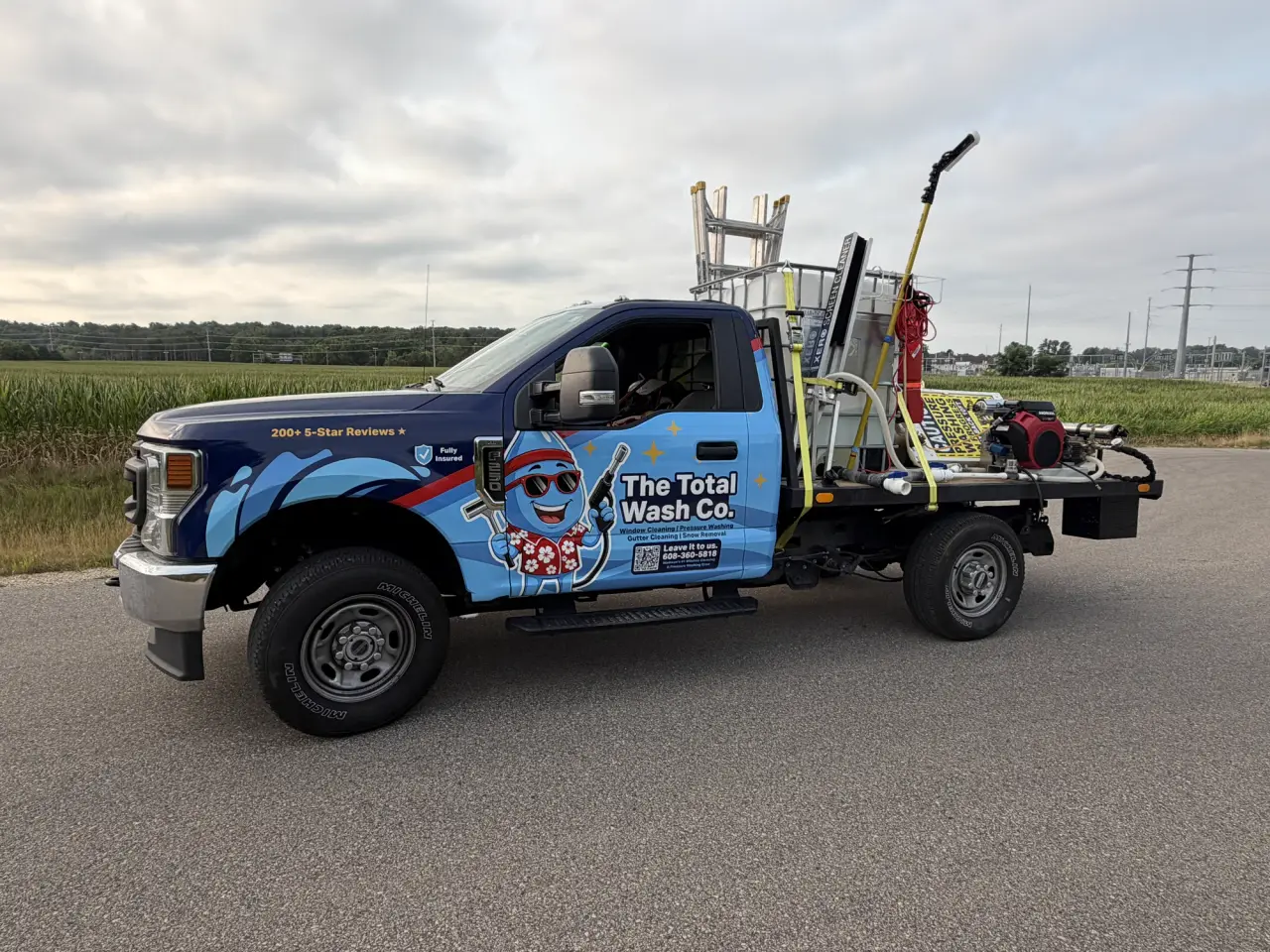
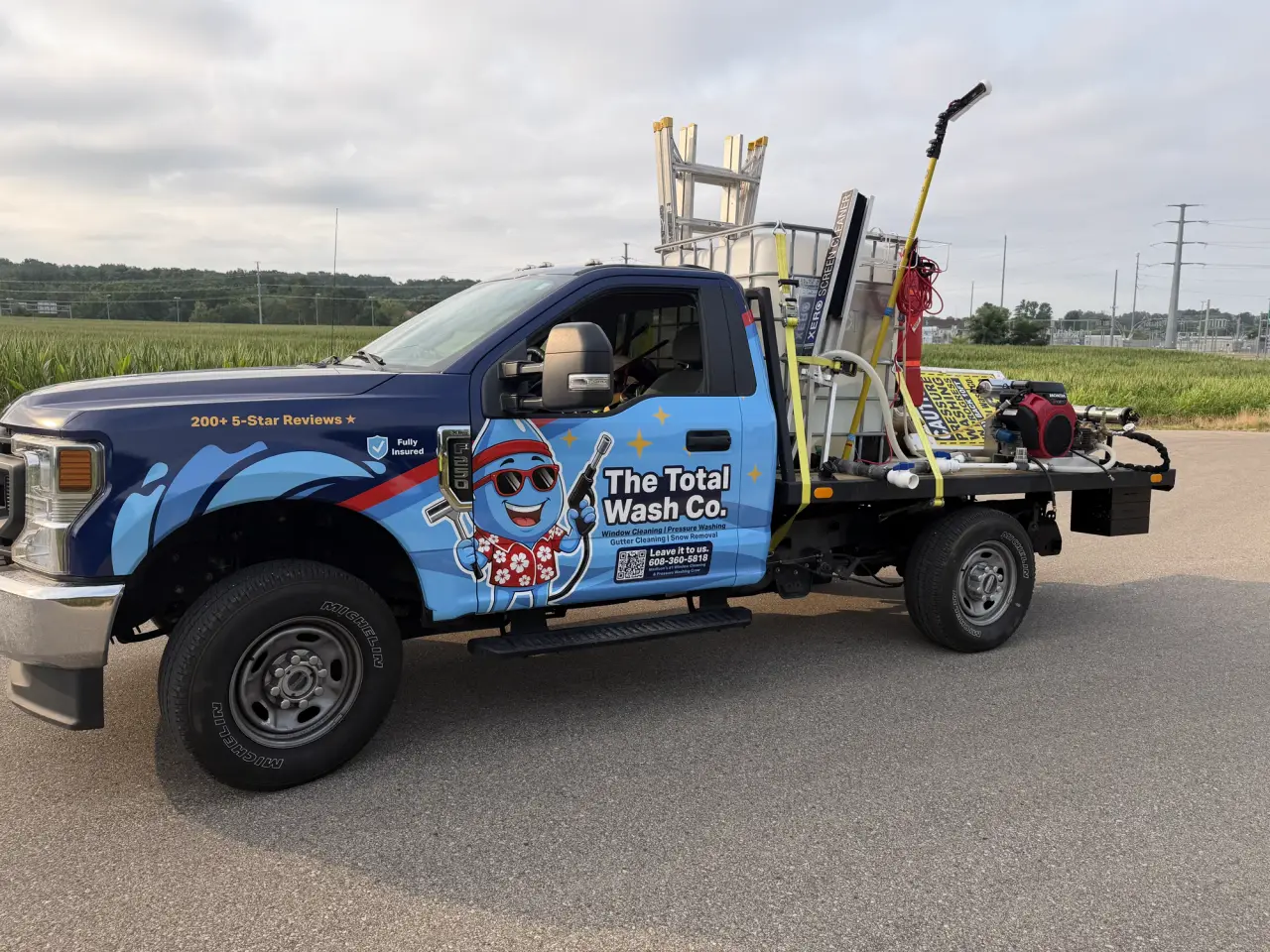
The Total Wash Co. runs commercial equipment on both trucks: 8 GPM pressure rigs (Honda GX690 engines, General Pump TSF2021 pumps) fed by 225- and 250-gallon buffer tanks, Whisper Wash surface cleaners, Water Dragon remote downstream injection, and Tucker Rival pure-water carts with carbon-fiber water-fed poles. Each item below is named and explained.
The wash rig
Each truck carries the same 8 GPM rig, fed by its own buffer tank, with a Whisper Wash surface cleaner for concrete. Flow is the number that matters here, not pressure — the pressure washer is pointed at concrete and nothing else.
8 GPM pressure-washing rig
one per truck
A commercial gas pressure washer built on a Honda GX690 engine turning a General Pump TSF2021 triplex pump, electric-started off a deep-cycle marine battery on the deck. It feeds a 3/8-inch by 200-foot hose on a reel, an MTM Hydro SGS28 trigger gun, and a J-rod wand with 8.0-orifice tips (25°, 40°, soap, turbo).
What it does for your home
Eight gallons a minute is the number that matters, not pressure. Volume rinses siding faster and gentler through a wide 40° fan held off the wall, drives the surface cleaner evenly across concrete, and gets us off your property sooner. Two hundred feet of hose means the truck stays on the street.
Why we chose it
The GX690 is the engine most commercial rigs are built around and the TSF2021 is a rebuildable pump, not a throwaway; we flush both with clean water after every job because the chemistry would otherwise eat the seals.
What it replaces
Pressure as the tool. A homeowner unit moves two or three gallons a minute and tempts people to make up the difference with force; that's how vinyl gets scarred and mortar gets blown out.
What we never do with it
- Point it at siding, shingles or glass at high pressure.
- Run it without the buffer tank.
- Leave SH in the pump.
| Flow | 8 GPM |
| Engine | Honda GX690 |
| Pump | General Pump TSF2021 (triplex) |
| Gun | MTM Hydro SGS28 |
| Wand | J-rod with 8.0-orifice tips (25°, 40°, soap, turbo) |
| Hose | 3/8 in × 200 ft on a reel |
| Start | Electric, off a deep-cycle marine battery |
Buffer tanks — 225 gal (2012 truck) / 250 gal (2020 truck)
one per truck
A water tank on each deck with a float valve, filled from your spigot while we set up. The 2012 truck carries 225 gallons; the 2020 carries 250.
What it does for your home
Your spigot gives about 3 to 5 gallons a minute. The rig drinks 8. Without the tank in between, the pump would starve and stutter and the wash would come out in surges — the tank lets the rig run at full, even flow while your hose bib quietly refills it behind us.
Why we chose it
Big enough to run a whole wall without waiting; low enough on the deck to keep the truck stable. Two sizes only because the two decks are different sizes.
What it replaces
The pause-and-wait routine, and the temptation to turn the pressure up because the flow isn't there.
What we never do with it
- Run the rig straight off a spigot with the tank bypassed.
- Start a wall on a quarter tank — the pump starves mid-pass and the wash goes streaky.
Close-up photo coming from the next shop-day shoot.
| 2012 truck | 225 gallons |
| 2020 truck | 250 gallons |
| Feeds | The 8 GPM rig |
| Typical spigot | About 3–5 GPM |
Whisper Wash surface cleaners — 28-inch (2012 truck) / 24-inch Ground Force (2020 truck)
one per truck
A hooded, spinning two-nozzle bar that rides flat on concrete, fed by the 8 GPM rig.
What it does for your home
An even, stripe-free finish — the "zebra" marks on wand-washed driveways come from overlapping hand passes, which the bar eliminates. The hood contains spray so siding, cars and beds stay dry, and a 24- to 28-inch swath gets the drive done in a fraction of the time.
Why we chose it
Whisper Wash is the pro-standard bar; two sizes because the 28-inch eats lots and driveways and the 24-inch turns in patios and walks.
What it replaces
Wand-only cleaning and the temptation to reach for a turbo nozzle.
What we never do with it
- Stop mid-pass — a two-second stop leaves a circle.
- Run it without an SH pre-treat.
- Use a turbo nozzle on stamped, aggregate or sealed concrete.
Close-up photo coming from the next shop-day shoot.
| 2012 truck | 28-inch Whisper Wash |
| 2020 truck | 24-inch Whisper Wash Ground Force |
| Fed by | The 8 GPM rig |
MTM Hydro SGS28 trigger gun, J-rod wand and 8.0-orifice tips
one set per truck
The business end of the rig: an MTM Hydro SGS28 trigger gun, a J-rod wand that flips between a soap tip and a rinse tip without a trip back to the truck, and a set of 8.0-orifice nozzles — 25°, 40°, soap and turbo.
What it does for your home
The tip decides what touches your house. The soap tip is a wide, low-pressure fan that lays chemistry on without driving it under the siding. The 40° rinse tip, held a couple of feet off the wall, floods the dirt away with volume. The 25° is for concrete edges and steps. The turbo nozzle is a last resort for bare, unsealed concrete — it never sees siding, pavers, stamped or sealed surfaces.
Why we chose it
The J-rod flip means we switch from applying to rinsing in a second, so chemistry never sits longer than it should because someone was walking back for a different wand. The 8.0 orifice is sized to the 8 GPM pump — a smaller tip on a big pump is how pressure creeps up without anyone meaning it to.
What it replaces
A single all-purpose wand — and the guesswork about whether the next pass is soap or water.
What we never do with it
- Turbo nozzle on siding, pavers, or stamped, aggregate or sealed concrete.
- A tip smaller than the pump is sized for.
- The rinse tip closer than about two feet to vinyl.
Close-up photo coming from the next shop-day shoot.
| Gun | MTM Hydro SGS28 |
| Wand | J-rod (soap / rinse flip) |
| Tips | 8.0 orifice — 25°, 40°, soap, turbo |
3/8-inch × 200 ft pressure hose on a reel
one per truck
Two hundred feet of 3/8-inch high-pressure hose on a reel mounted to the deck, quick-connected to the gun at one end and the pump at the other.
What it does for your home
The truck stays on the street. Two hundred feet reaches around most Madison lots without backing a loaded truck into your driveway, across your lawn or up against the flower beds — and without bringing the rig's exhaust up to your open windows.
Why we chose it
3/8 inch is the diameter that carries 8 gallons a minute to the far end without choking the flow — a skinnier hose would turn our volume into pressure, the opposite of what siding wants. The reel is there so the hose comes off and goes back on in a minute and never lies kinked in your yard.
What it replaces
Repositioning the truck mid-job — and a garden-hose-sized line that would waste half the pump.
What we never do with it
- Drag the hose across a wall we've just rinsed or through a soaked bed.
- Run it kinked or under a tire — that is how a hose fails under pressure.
Close-up photo coming from the next shop-day shoot.
| Hose | 3/8 in × 200 ft |
| Mount | Reel on the deck |
Deep-cycle marine battery (electric start)
one per truck
A deep-cycle marine battery in a box on the deck, wired to the rig's electric start.
What it does for your home
Nothing you'll notice — which is the point. The rig starts on a key, every time, so a job never turns into a pull-cord wrestling match in your driveway, and the engine comes back up in a second when we've shut it down to move the ladder or talk to you.
Why we chose it
A marine battery is built to be drained and recharged over and over without complaint. A car battery isn't, and a rig that won't start at 8 a.m. is a rescheduled job.
What it replaces
The pull cord, and a second trip to the truck every time the engine needs to come back up.
What we never do with it
- Head out on a battery that wasn't on the charger overnight.
- Turn the key with the pump dry — water flows through the pump before the engine does.
Close-up photo coming from the next shop-day shoot.
| Type | Deep-cycle marine |
| Powers | The rig's electric start |
Soft-wash delivery, and the kit that keeps it off everything else
There is no separate soft-wash machine on our trucks, and we won't pretend there is. Soft washing is the same rig at low pressure, drawing sodium hypochlorite through a downstream injector so it lands on your siding at about 0.75 to 1% — plus the plant hose, tarps and covers that keep it where it belongs.
Water Dragon remote downstream bypass (stainless)
both trucks
A stainless-steel remote bypass plumbed into the rig's downstream line. A remote on the tech's belt switches the injector between drawing chemical and drawing plain water.
What it does for your home
When the mix is on your wall and it's time to rinse, we don't walk back to the truck and pull a hose off a jug — we press a button and the line goes to clean water on the spot. Chemistry sits exactly as long as it should, the rinse starts on time, and the plants that were just re-wet don't wait.
Why we chose it
A remote-controlled bypass takes the walk out of the switch, and the walk is where dwell times drift. Stainless because the parts live in a sodium hypochlorite line all season; brass and plain steel corrode there.
What it replaces
Walking back to the truck to move the draw line — and the guesswork about how long the chemical actually sat.
What we never do with it
- Let the chemical sit past its dwell because the switch is a walk away — with the remote, it never is.
- Shut the rig down with the bypass on chemical — SH does not stay in the pump.
- Trust the switch without a draw test at the start of the job.
Close-up photo coming from the next shop-day shoot.
| Type | Remote downstream bypass |
| Body | Stainless steel |
Super Suds Sucker stainless downstream injector
both trucks
A stainless-steel venturi injector on the low-pressure side of the pump. As the rig's water rushes past a small opening, it pulls sodium hypochlorite and surfactant up a draw line and blends them into the stream — that blending is the "downstreaming" you'll see in our glossary.
What it does for your home
It's the reason the chemical on your siding is about 0.75 to 1%, not 12. The injector meters chemistry into 8 gallons a minute of water, and because it sits after the pump, the pump itself only ever sees clean water. The ratio is fixed by the injector, so it's the same on your house as on the last one.
Why we chose it
Stainless survives a season of bleach; brass and plated injectors pit and drift. A downstream injector is also the gentlest way to get chemistry to a wall — the pump never touches it, and the chemical only ever leaves the soap tip at low pressure.
What it replaces
Pump sprayers on a house — and mixing "by eye" in a bucket, which is how a wash gets too strong for a wall.
What we never do with it
- Guess the ratio — a draw test into a marked bucket at the start of the day proves it.
- Draw anything through it but water, SH and Elemonator.
- Let SH sit in it overnight — it gets flushed with clean water after every job.
Close-up photo coming from the next shop-day shoot.
| Type | Downstream (venturi) injector |
| Body | Stainless steel |
| On the wall | About 0.75–1% SH |
Plant hose, tarps and HVAC covers
both trucks
A garden hose on its own reel with a spray nozzle, a stack of tarps, painter's tape, and covers for the outdoor HVAC condenser, outlets, the doorbell and cameras.
What it does for your home
This is the kit that answers the first question we get: "What about my plants?" Every plant and bed within about 15 feet of a wall gets soaked with plain water before the first spray, re-wet during the dwell, and flooded after the wall is rinsed. Anything delicate — hydrangeas, hostas, roses, a bed planted this spring — gets a tarp. The condenser gets a cover, because sodium hypochlorite corrodes aluminum fins.
Why we chose it
A separate plant hose means the plant line is never the chemical line. Tarps are cheap; the rose bush your grandmother planted isn't.
What it replaces
Hoping the runoff misses the beds.
What we never do with it
- Start a wall before the beds under it are wet.
- Spray anywhere near an uncovered condenser.
- Leave without the after-rinse and the neutralizer on every bed we worked above.
Close-up photo coming from the next shop-day shoot.
Pure water for windows
Madison tap water runs 300 to 550 ppm of dissolved minerals. That's the spotting you see after a rain. Every window we clean gets water filtered to under 10 ppm, tested at the brush before the first pane.
Tucker Rival pure-water cart
one per truck
A four-stage filtration cart with a DI Saver stage that turns tap water into near-zero-mineral water, pumped up a carbon-fiber pole to a brush head with jets. A shared XERO Complete three-stage kit rides as backup; North Star pumps push the water.
What it does for your home
Madison tap runs 300–550 ppm of dissolved minerals — that's the spotting you've seen after a rain. We test at the brush before the first window and clean only under 10 ppm, so the glass dries spot-free with no soap, no towel, and nothing left behind to attract dirt. The brush scrubs frames and sills at the same time, and second-story glass gets done from the ground.
Why we chose it
The DI Saver is the difference on hard Madison water — carts without it burn through resin and start spotting mid-job. The pole is carbon fiber because a heavy pole means a rushed window.
What it replaces
Ladders against your siding for most upper windows, and detergent film.
What we never do with it
- Clean glass with water over 10 ppm — the meter reads at the brush before the first window.
- Skip the test because the resin "should" be fine — Madison water burns through resin.
- Run a pure-water job below freezing.

| Stages | 4, with DI Saver |
| Madison tap | 300–550 ppm |
| At the brush | Under 10 ppm |
| Pumps | North Star |
XERO carbon-fiber water-fed pole
both trucks
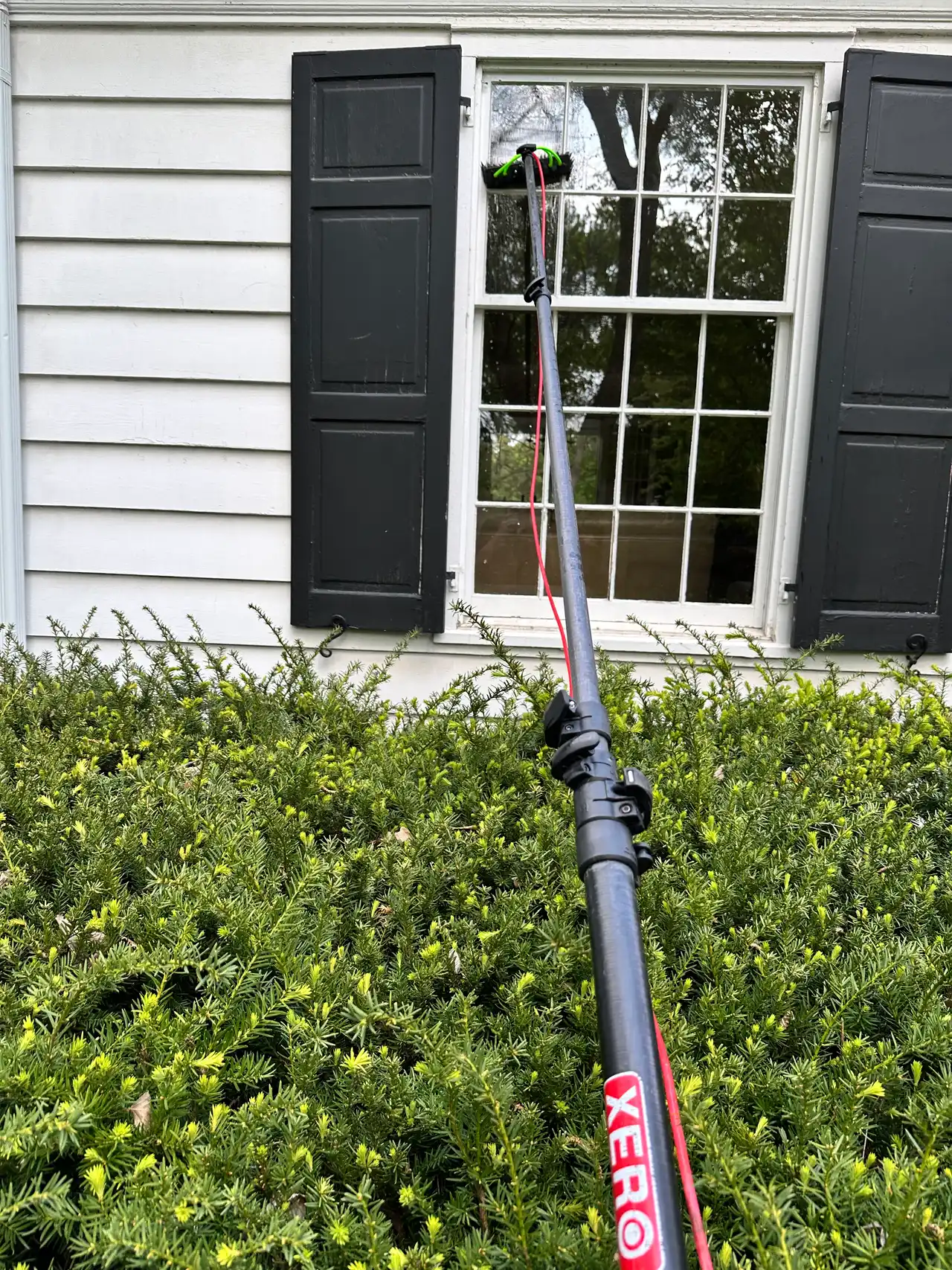
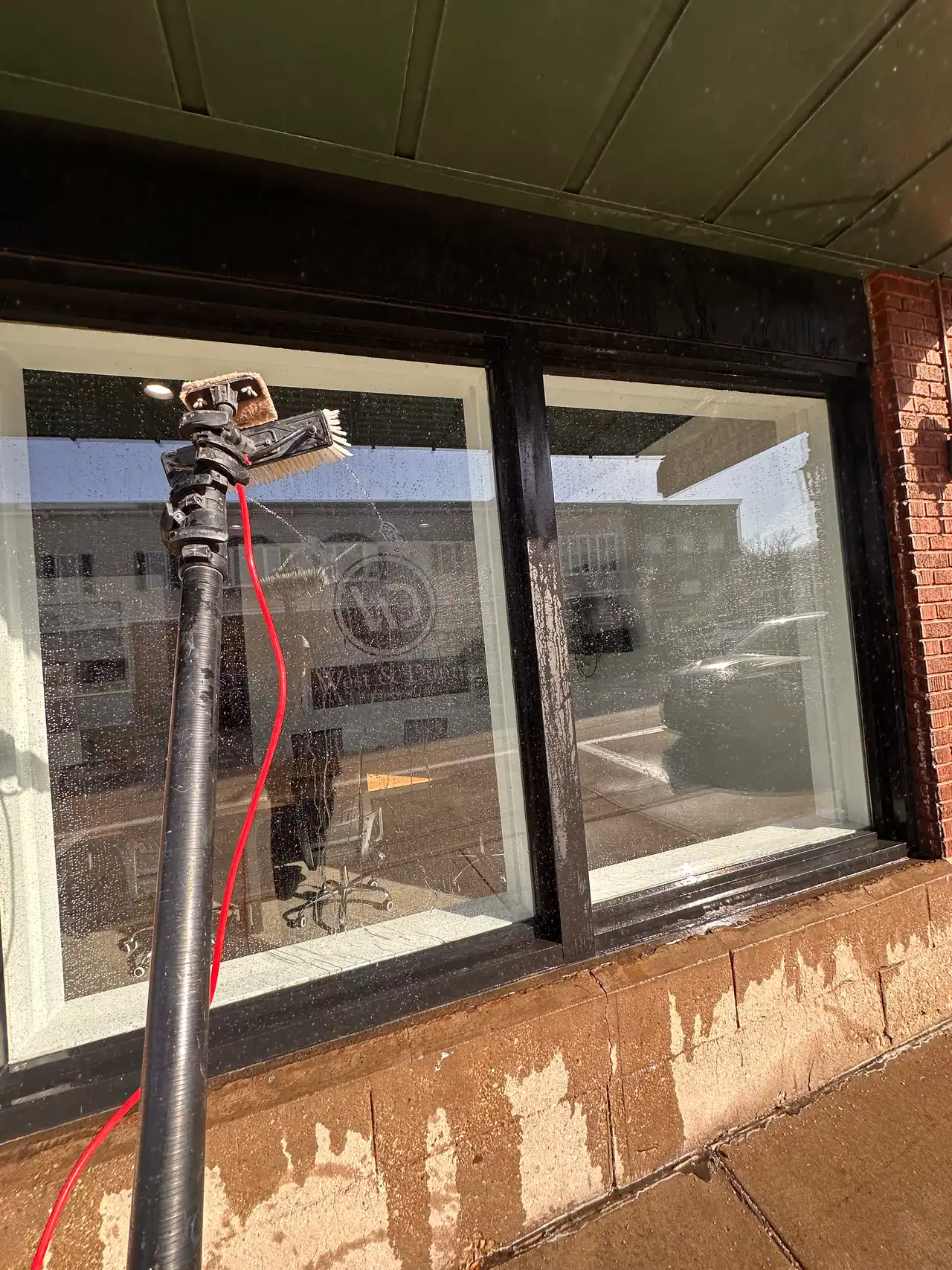
A telescoping carbon-fiber pole — the one in this photo is XERO's — with a soft-bristle brush head and rinse jets on the end, fed with pure water from the cart. It reaches second-story glass with both feet on the lawn.
What it does for your home
The brush scrubs the frame, the sill and the pane; the jets rinse the dirt down with pure water; and because there is nothing dissolved in that water, the glass dries spot-free with no towel and no squeegee. No ladder against your siding, no boots on your roof, and a second-story window takes the time it needs instead of the time a ladder allows.
Why we chose it
Carbon fiber, because a heavy pole means a rushed window. At full extension the difference between carbon and aluminum is whether the tech is still scrubbing the corners on the last window of the day.
What it replaces
Ladders against your house for most upper windows, and a wobbly aluminum pole that turns into a shortcut by 3 p.m.
What we never do with it
- Touch the pane before the frame and top sill are scrubbed — the dirt would just run back over the glass.
- Finish with the brush on the glass — the last pass is jets only, off the pane, so it sheets clean.
- Extend it anywhere near a power service drop.
| Material | Carbon fiber |
| Brand in the photo | XERO |
| Reach | Second-story glass from the ground |
XERO Complete kit (shared backup)
shared
A three-stage XERO pure-water kit that rides in whichever truck is on the bigger window job. It's the spare.
What it does for your home
If a cart's resin gives out mid-job — Madison water is hard enough that this is a when, not an if — the backup goes on the hose and the day continues at under 10 ppm. You don't get a rescheduled second half.
Why we chose it
Because "the cart went down" is not something a homeowner should ever hear. Two trucks, two carts, one spare.
What it replaces
A rescheduled job.
What we never do with it
- Put it to work without the same TDS test the main cart gets.
- Let it become the main kit — it goes back to spare the same day.
Close-up photo coming from the next shop-day shoot.
| Stages | 3 |
| Role | Shared backup |
North Star window pumps
both trucks
The pumps that push pure water from the filtration cart up the pole to the brush.
What it does for your home
Flow at the brush is what carries dirt off the glass. A steady pump means a steady sheet of water on the pane, so the rinse actually rinses instead of dribbling — that's the difference between spot-free and "mostly clean."
Why we chose it
They hold a steady flow all day on the truck, and a steady flow is the whole point.
What it replaces
Gravity — and a tap-pressure hose that can't push water two stories up.
What we never do with it
- Run it dry.
- Push tap water through it to "save the resin" — every drop that reaches the glass has been through the cart.
Close-up photo coming from the next shop-day shoot.
| Job | Pushes pure water from the cart up the pole |
TDS meter
A handheld meter that reads total dissolved solids — the minerals in water — in parts per million. It goes in the spigot water first, then under the brush.
What it does for your home
It's the proof behind "spot-free." Spots are what's left when a drop of mineral water dries. Madison tap reads 300 to 550 ppm; we clean glass only under 10. Before the first window on every job, the meter goes under the brush, and if the number is wrong the system gets fixed before your glass gets touched.
Why we chose it
Because "it looks clean coming out of the pole" isn't a measurement. Resin runs out quietly; the meter catches it before your window does.
What it replaces
Guessing.
What we never do with it
- Start a window before the reading.
- Accept a reading over 10 ppm because the last job was fine.
Close-up photo coming from the next shop-day shoot.
| Madison tap | 300–550 ppm |
| We clean glass at | Under 10 ppm |
Hand tools
Generic tools, kept sharp. A squeegee is a squeegee; the skill is in the hand holding it, and the rubber gets swapped the moment it leaves a line.
Squeegees, channels, T-bars and scrapers
both trucks
The hand kit for ground-floor and interior glass: T-bars with microfiber sleeves to scrub, squeegee channels with fresh rubber to pull the water off, a scraper for paint flecks and bug spots, and towels for the edges. Generic tools, fresh rubber — the brand isn't the skill.
What it does for your home
Where a pole can't go — inside, under a porch roof, a storefront at eye level — the glass gets scrubbed with the T-bar, pulled dry with the squeegee in one continuous stroke, and the edges detailed with a towel. Done right, there's no streak and no drip line on the sill.
Why we chose it
Rubber gets swapped the moment it leaves a line. The scraper is for wet glass only, and if a spot turns out to be paint overspray or a failed seal we tell you instead of scraping harder.
What it replaces
Paper towels and glass spray — which push dirt around and leave lint and film.
What we never do with it
- A dry scraper on glass.
- A squeegee with nicked rubber.
- Interior work that isn't on the quote.
Close-up photo coming from the next shop-day shoot.
Gutter scoop and blower
both trucks
A gutter scoop shaped to the trough, a bucket on the ladder, and a blower for the light, dry litter and for clearing the roof edge and your walks when we're done.
What it does for your home
Packed, wet leaf mat comes out by hand and scoop — that's the only thing that actually moves it. The blower handles the dry stuff and gets the shingles and your walks clear of what we knocked loose. Then a hose flushes every downspout until it runs clear at the bottom.
Why we chose it
Because a scoop is honest. Wet mat doesn't blow, doesn't pull through a tube, and doesn't move with a pressure washer without flooding the fascia. Hands and a scoop, then a flush.
What it replaces
Blowing wet debris around your yard, and "gutter cleaning" that never checks whether the downspout flows.
What we never do with it
- A pressure washer down a downspout — it blows joints apart and packs the clog tighter.
- Leave the roof edge or your walks covered in what we pulled out.
- Call a gutter clean done before every downspout runs clear at the bottom.
Close-up photo coming from the next shop-day shoot.
Ladders and reach
Most upper-story glass is done from the ground with a pole. When a ladder comes out, it comes out with a standoff and levelers. We don't own a lift, and we say so.
Extension ladders with standoffs and levelers
both trucks
Extension ladders fitted with a standoff — a wide bracket that holds the ladder off the wall against the roof or siding, not the gutter — and levelers on the feet for a slope or a step.
What it does for your home
The standoff is what keeps a ladder from crushing or bending your gutter, and it holds the tech a comfortable arm's length from the work instead of pressed against the wall. Levelers mean the ladder is plumb on a sloped bed or a landscape wall, which is the difference between a safe set and a story.
Why we chose it
Most gutter damage in this trade is ladder damage. A standoff is an inexpensive fix for that, and a leveler is an inexpensive fix for the slope every Madison yard seems to have. We don't own a lift: when a mid-rise job needs one, it's rented for that job, and anything over five stories is rope access by a subcontractor.
What it replaces
A ladder on the gutter, and the overreach that happens when nobody wants to climb down and move it.
What we never do with it
- A ladder resting on a gutter.
- Overreach — we climb down and move the ladder.
- A ladder set in a soft bed without the feet checked.
- Tell you there's a lift on the truck. There isn't.
Close-up photo coming from the next shop-day shoot.
| Type | Extension ladders |
| Fitted with | Standoffs and levelers |
| Over five stories | Rope access, subcontracted |
Safety and disclosure
The gear that protects the person spraying chemistry at your house — and the binder that lets you read exactly what that chemistry is before we start.
PPE — respirator, glasses, gloves, ear protection
both trucks
P100/OV half-face respirators, ANSI Z87.1 safety glasses, nitrile gloves and ear protection on every truck, plus eyewash.
What it does for your home
It protects the person spraying chemistry at your house — which also tells you something about the chemistry. If it's worth a respirator for the tech standing in the mist all day, it's worth closing your windows, keeping the dog in during the wash, and letting us do the plant protocol without shortcuts.
Why we chose it
The half-face P100/OV respirator is the one we run for spray days. Z87.1 is the impact rating on glasses that should be on anyone near an 8 GPM rig. Nitrile because latex and bleach don't get along.
What it replaces
Sunglasses and a bandana.
What we never do with it
- Spray without eye protection.
- Handle concentrate without nitrile gloves.
- Run the rig without ear protection — it's a commercial engine, not a lawn mower.
Close-up photo coming from the next shop-day shoot.
| Respirator | P100/OV half-face |
| Glasses | ANSI Z87.1 |
| Gloves | Nitrile |
| Ears | Ear protection |
SDS binder
both trucks
A binder in each cab with the manufacturer's Safety Data Sheet for every chemical on that truck — sodium hypochlorite, Elemonator, Orange Krush, F9 BARC, Wood Wizard, Dynamite Degreaser, Gutter Butter and the neutralizer.
What it does for your home
You can ask to see the sheet for anything we're about to put on your house, and we'll hand it to you before we start. It's also what a tech reaches for if something gets in an eye or on skin — the first-aid section is the maker's, not our memory.
Why we chose it
The chemicals we use are honest chemicals with published hazards. A company that won't name its products can't show you a sheet; we'd rather name them and hand it over.
What it replaces
"It's just a soap."
What we never do with it
- Paraphrase a hazard statement from memory — we read you the maker's sheet.
- Carry a product without its sheet in the binder.
Close-up photo coming from the next shop-day shoot.
| Where | In each cab |
| Copy | On request, before we start |
Winter
The wash rigs come off, the plow goes on. Clear to pavement first, salt after, at the lowest rate that keeps it safe. Brands go on this page when we photograph the badges — until then it's "our plow", not a guess.
Our plow
mounts for the winter
A truck-mounted plow that goes on the front of an F-250 once the wash season ends. We'll put the make on this page when we photograph the badge; until then it's "our plow", not a brand we're guessing at.
What it does for your home
It clears to pavement, which is the whole game. Salt only works on a surface that's already been cleared — spread on packed snow it just makes slush that refreezes — so the plow pass comes first, aprons get back-dragged, and the blade gets feathered near pavers and garage doors.
Why we chose it
It rides on an F-250 because that's the truck that's already ours, already insured and built to push. The 2020's 7.3L V8 was bought with winter in mind.
What it replaces
A subcontracted plow that shows up on someone else's schedule.
What we never do with it
- Salt on top of packed snow.
- Push snow onto a public road.
- Chip ice off concrete or shingles with a blade or a bar.
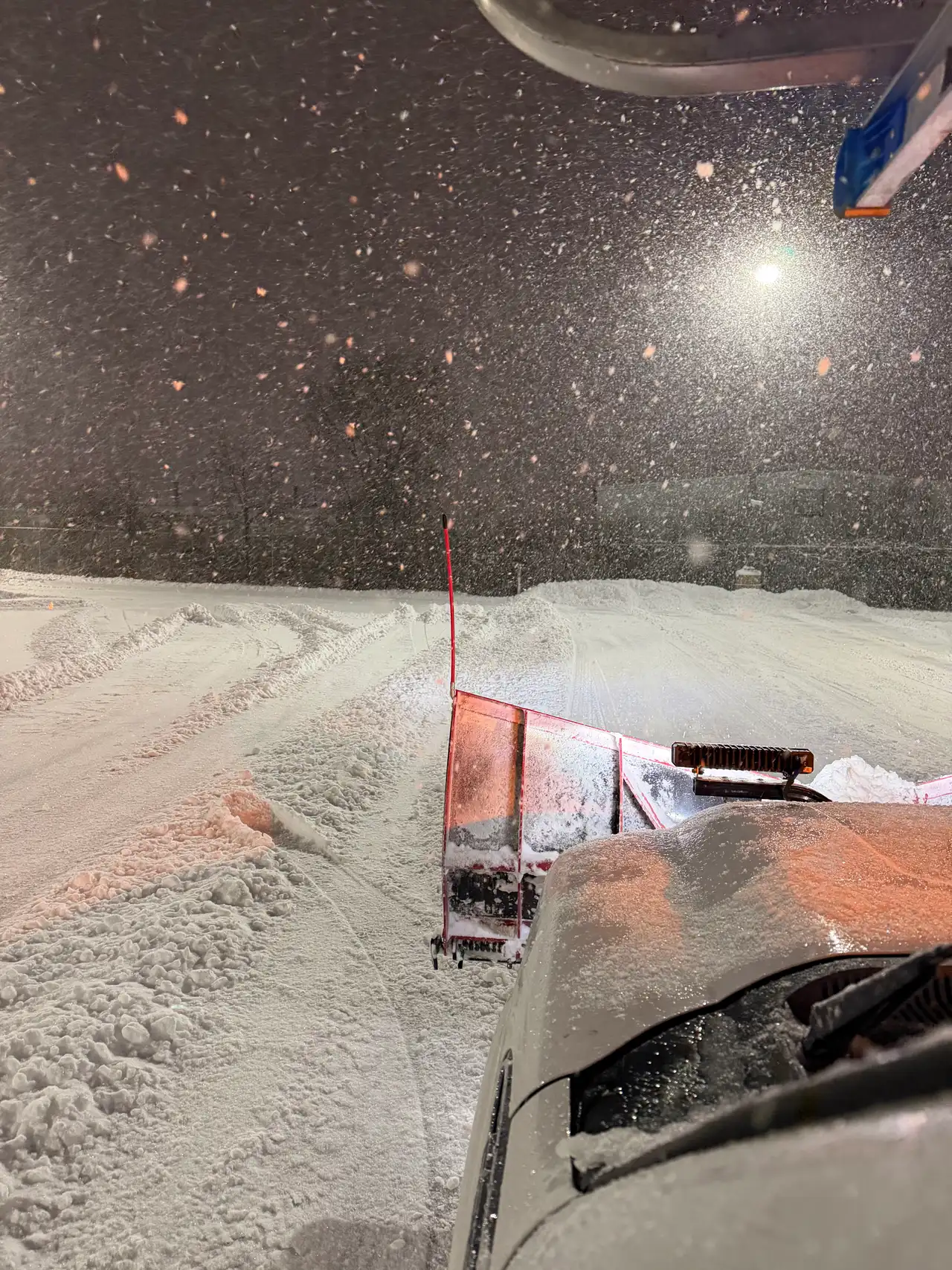

| Mounts on | Ford F-250 |
Salt spreader and ice melt
A truck-mounted spreader for rock salt, loaded and calibrated before the route, plus bagged ice melt for steps and walks by hand. Brand and hopper size go on this page when they're photographed.
What it does for your home
It puts down the least salt that keeps the surface safe, after the plow has cleared to pavement — steps and slopes first. Less salt is better for the concrete we washed for you in spring and for the grass along the edge, and it still keeps the lot open before anyone arrives.
Why we chose it
A calibrated spreader is the difference between "salted" and "salted right." We don't publish pounds per lot because we haven't measured a number worth publishing — we publish the rule: minimum effective, after clearing, never before.
What it replaces
A scoop from a bucket, and the white crust that says someone over-salted.
What we never do with it
- Spread before the plow pass.
- Salt frozen slush instead of clearing it.
- Over-salt the concrete we cleaned in spring.
Close-up photo coming from the next shop-day shoot.
Snow blower, shovels and roof rake
A snow blower for walks and the spots a blade can't reach, shovels for steps and doorways, and a roof rake — a long-handled blade for pulling snow off the lower roof edge from the ground.
What it does for your home
Walks and steps get cleared by blower and shovel because a plow can't do them and salt alone won't. The roof rake pulls the first few feet of snow off the eave from the ground, which is where ice dams start — snow on a warm roof melts, runs to the cold edge and freezes into a dam that backs water under the shingles.
Why we chose it
The rake is on the truck because the alternative is someone on a snowy roof, and that's a fall. We rake from the ground, and we don't chip ice off shingles — the ice comes off on its own once the snow above it is gone.
What it replaces
A ladder on an icy roof.
What we never do with it
- Step onto a snowy roof — we rake from the ground.
- Chip ice off shingles or concrete.
- Blow snow onto a neighbor's cleared walk or into the street.
Close-up photo coming from the next shop-day shoot.
What we never do
- Never high pressure on siding, roofs or glass.
- Never run the rig off a spigot alone — the buffer tank is on every job.
- Never clean glass with water over 10 ppm.
- Never a turbo nozzle on stamped, aggregate or sealed concrete.
- Never a ladder resting on a gutter — standoff on, every time.
- Never claim gear we don't own: no hot-water unit, no lift, no drone cleaning, no dedicated soft-wash pump.
See what this gear does on your place
Every price is built from your actual property. Most estimates come back within a few hours.