Deionized Water
Deionized water — often shortened to DI water — is water that has had essentially all of its dissolved mineral ions removed by passing it through specialized ion-exchange resin beads. Positive-charge ions (sodium, calcium, magnesium) are swapped for hydrogen ions, and negative-charge ions (chloride, sulfate, bicarbonate) are swapped for hydroxide ions. The result is near-pure H2O with a TDS reading at or near zero.
In depth
In exterior cleaning, DI water is the final polish in a multi-stage window cleaning filtration system. A pre-filter removes sediment, a carbon filter strips chlorine (which destroys DI resin), reverse osmosis takes TDS down to 5-20 PPM, and a DI tank polishes the rest of the way to zero. Because the resin has a finite capacity, technicians track TDS at the outlet to know when to recharge or swap the tank. DI water is also "hungry" — it actively pulls minerals off whatever it touches — which is why it leaves glass so perfectly spot-free.
How this shows up on our jobs
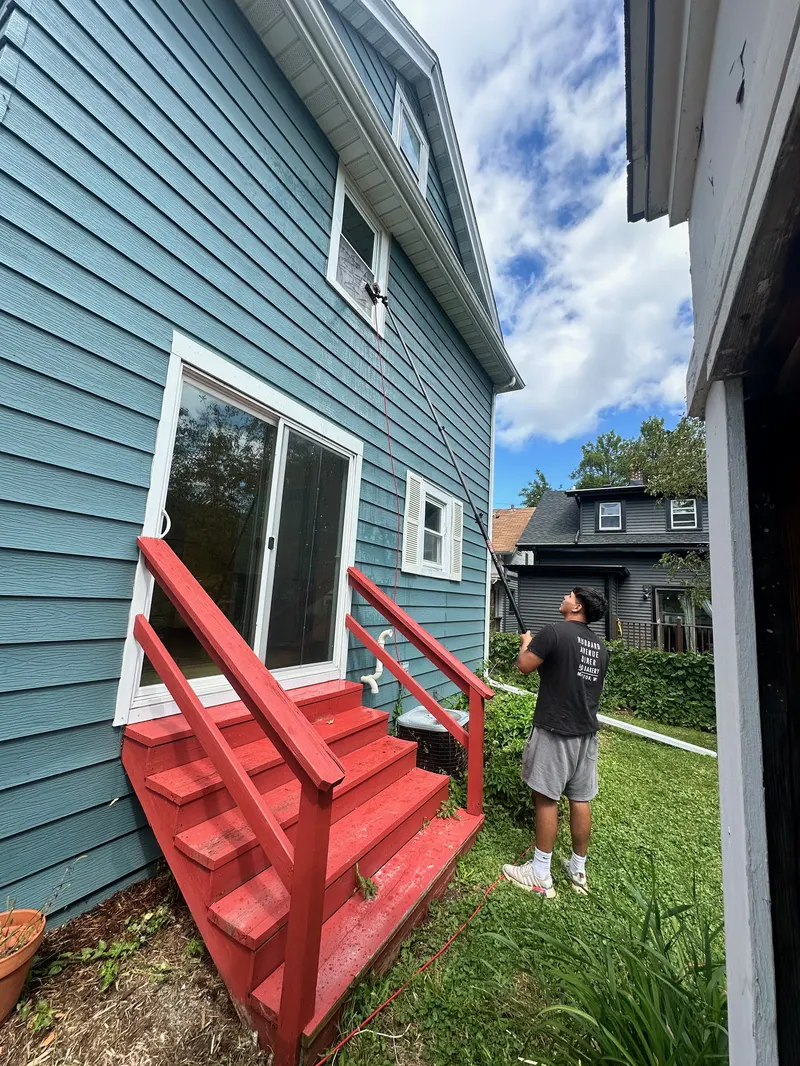
Every drop of rinse water that touches a window we clean has been polished to 0 TDS through our on-truck DI system, which is why our windows dry spot-free even in direct Madison sun.
Services where this matters
Frequently asked
- What is Deionized Water?
- Deionized water — often shortened to DI water — is water that has had essentially all of its dissolved mineral ions removed by passing it through specialized ion-exchange resin beads. Positive-charge ions (sodium, calcium, magnesium) are swapped for hydrogen ions, and negative-charge ions (chloride, sulfate, bicarbonate) are swapped for hydroxide ions. The result is near-pure H2O with a TDS reading at or near zero.
- How does Deionized Water show up on our jobs?
- Every drop of rinse water that touches a window we clean has been polished to 0 TDS through our on-truck DI system, which is why our windows dry spot-free even in direct Madison sun.
Need window cleaning in Madison?
Free quotes — most estimates back within a few hours. Prefer to talk? Call us anytime.
Related terms
TDS (Total Dissolved Solids)
TDS stands for Total Dissolved Solids — the concentration of dissolved minerals, salts, and metals in water, measured in parts per million (PPM). A TDS meter is the single most important tool in professional window cleaning because it determines whether rinse water will dry spot-free. Standard Madison tap water measures roughly 250-400 PPM, which leaves visible mineral spots on glass when it dries. For streak-free, squeegee-free results with a water-fed pole, rinse water must be at or below 10 PPM, and ideally 0-2 PPM.
Reverse Osmosis (RO)
Reverse osmosis is a water purification technology that uses pressure to force water through a semi-permeable membrane so fine that it blocks dissolved minerals, bacteria, and most organic molecules while letting pure water pass. In pressure-washing and window-cleaning applications, RO is the second filtration stage: it takes municipal tap water from 250-400 PPM of Total Dissolved Solids (TDS) down to roughly 5-20 PPM before the water hits the deionization resin.
Water-Fed Pole (WFP)
A water-fed pole is a lightweight telescoping pole — typically carbon fiber, 20 to 45 feet long — with a soft brush and water jets at the tip, fed by a hose connected to a pure-water filtration system. The technician agitates the glass with the brush while pure water rinses away the loosened dirt, leaving zero mineral residue to dry into spots. When done correctly, windows, frames, and screens air-dry crystal-clear without ladders or squeegees.
Hard Water Stain
A hard water stain is the crystalline mineral deposit that forms on glass, metal, and stone when water high in dissolved calcium, magnesium, iron, or silica evaporates and leaves its dissolved minerals behind. The stain starts as a cosmetic film that rinses off easily; over weeks or months, it bonds chemically to the surface and etches into it, becoming progressively harder to remove. On glass, severe hard-water staining is technically etching — the minerals have chemically fused into the silicate surface and cannot be washed off without specialty chemistry or mechanical polishing.