Surface Cleaner
A surface cleaner is a circular attachment — typically 16, 20, or 24 inches in diameter — that replaces the wand on a pressure washer for cleaning flat horizontal surfaces. Inside the housing, two or four high-pressure nozzles spin on a swivel bar, blasting the surface at a consistent angle and distance while a skirt contains the spray. The result: an even, streak-free clean across a driveway, patio, or sidewalk in a fraction of the time a wand would take — and without the wand-streak "zebra stripes" that plague amateurs.
In depth
Surface cleaners require real GPM to work. A consumer pressure washer at 2 GPM will stall the spinner and deliver poor results; a 4-8 GPM commercial rig keeps the bar spinning at the right RPM and delivers even pressure across the full sweep. Pros size the surface cleaner to the machine: a 5.5 GPM rig is best paired with an 18-20 inch head; an 8 GPM rig can drive a 24-inch head at production pace. It is the single most productivity-boosting tool in exterior cleaning.
How this shows up on our jobs
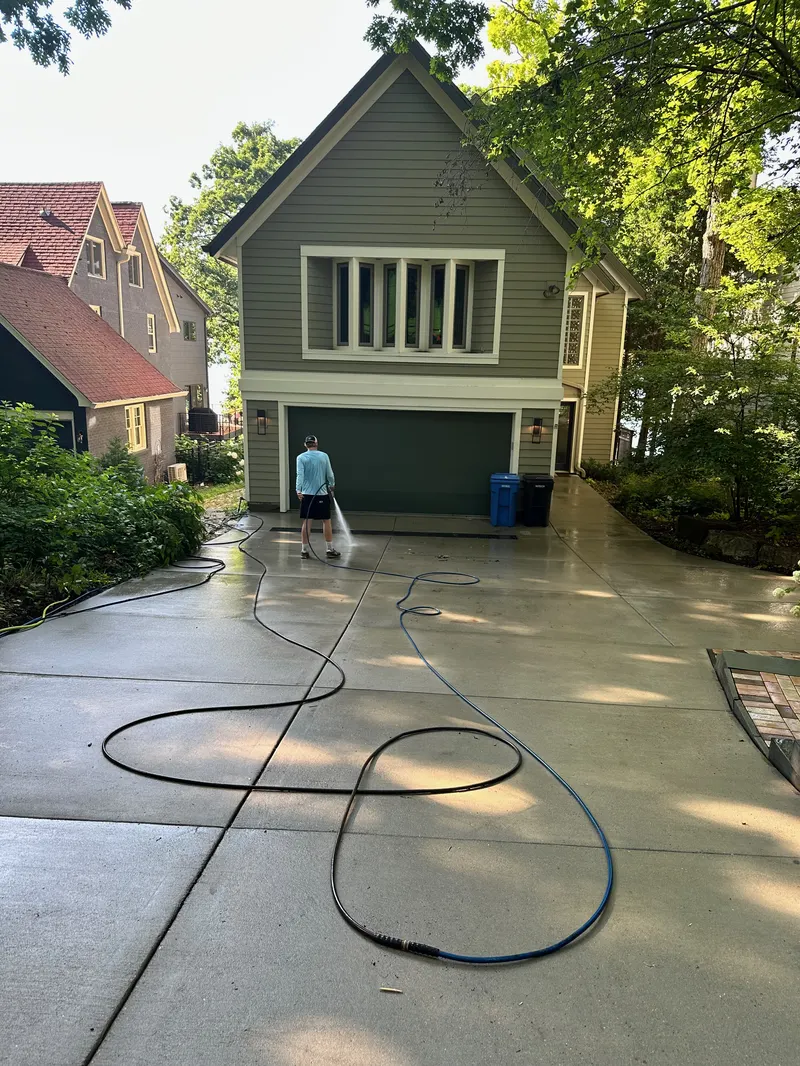
Every driveway, patio, sidewalk, and parking lot we clean starts with a surface cleaner. It is the difference between a 30-minute clean job and a 2-hour wand streak.
Services where this matters
Frequently asked
- What is Surface Cleaner?
- A surface cleaner is a circular attachment — typically 16, 20, or 24 inches in diameter — that replaces the wand on a pressure washer for cleaning flat horizontal surfaces. Inside the housing, two or four high-pressure nozzles spin on a swivel bar, blasting the surface at a consistent angle and distance while a skirt contains the spray. The result: an even, streak-free clean across a driveway, patio, or sidewalk in a fraction of the time a wand would take — and without the wand-streak "zebra stripes" that plague amateurs.
- How does Surface Cleaner show up on our jobs?
- Every driveway, patio, sidewalk, and parking lot we clean starts with a surface cleaner. It is the difference between a 30-minute clean job and a 2-hour wand streak.
Need surface cleaning in Madison?
Free quotes — most estimates back within a few hours. Prefer to talk? Call us anytime.
Related terms
PSI (Pounds per Square Inch)
PSI is the unit of pressure used to rate pressure washers, measuring the force of water exiting the pump per square inch of surface area. Consumer pressure washers run 1,500-2,500 PSI; professional rigs typically produce 3,500-5,000 PSI; and specialty surface cleaners can spike above 8,000 PSI. Higher PSI is not always better — in fact, for most home exterior surfaces, high PSI is destructive. Vinyl siding, wood shingles, soft mortar, roof granules, and painted surfaces all fail under excessive pressure.
GPM (Gallons per Minute)
GPM stands for Gallons Per Minute — the volume of water a pressure washer delivers per minute of operation. While PSI gets the headlines, GPM is what actually does the cleaning. Think of it this way: PSI is the hammer's strength; GPM is how many hammers you're swinging. Higher GPM means more water flowing across the surface, which means faster dirt removal, better rinsing of detergents, and shorter job times.
Pressure vs. Volume
Pressure (PSI) and volume (GPM) are the two fundamental outputs of a pressure washer, and understanding the tradeoff between them is the single biggest step an amateur can take toward professional-level results. Pressure is the force of water hitting a single point; volume is the amount of water moving across a surface over time. A high-PSI, low-GPM machine cleans a tiny spot aggressively — great for lifting paint, terrible for washing a driveway. A moderate-PSI, high-GPM machine cleans broadly and gently — great for siding, wood, and most large surfaces.
Hot Water Pressure Washing
Hot water pressure washing uses a diesel-fired burner to heat the pressure washer's output to 180-200°F before it hits the surface. The physics is simple: hot water dissolves grease and oil, accelerates chemical reactions, lowers the dwell time needed for detergent to work, and kills biological growth on contact. Cold-water pressure washing relies on mechanical force and chemistry alone, which means longer jobs and lower performance on greasy substrates.