Concrete Scaling
Concrete scaling is the peeling away of the thin top layer of a slab, leaving a rough, pitted surface with exposed stone. It is caused mainly by de-icing salt and freeze-thaw cycles acting on concrete that was not air-entrained or sealed. It is most common on driveways, walks, and steps.
Need this done on your property? See our pressure washing in Madison page.
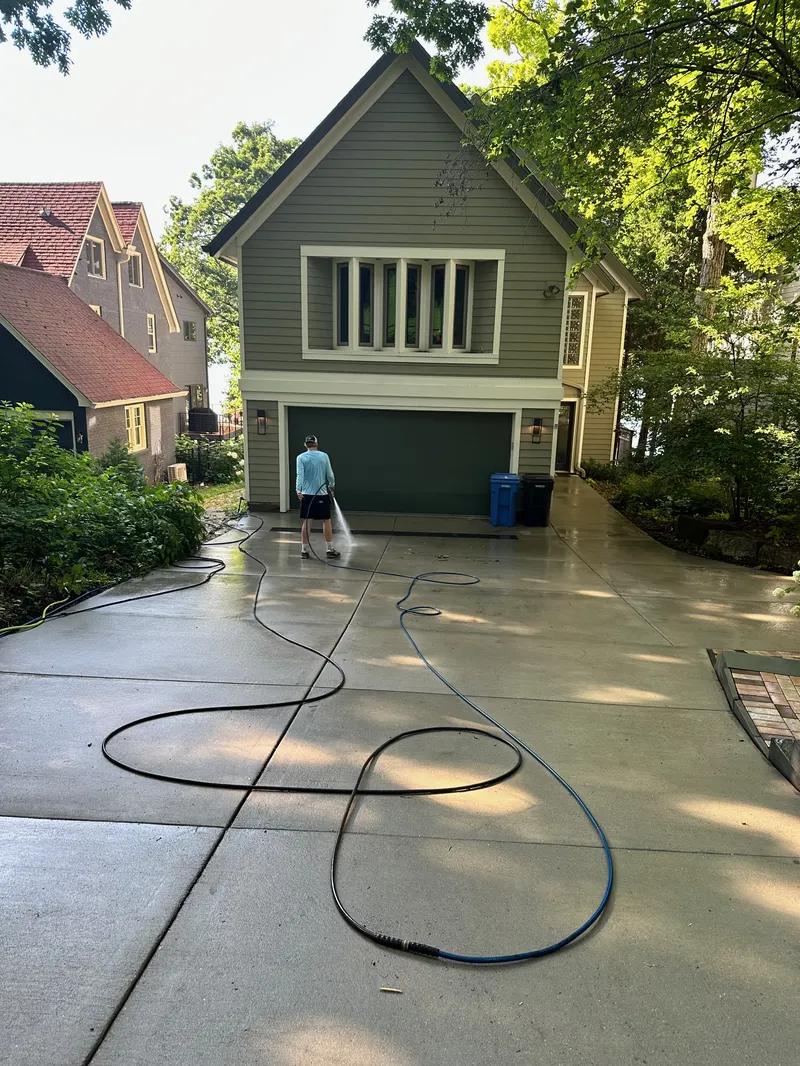
In depth
Scaling differs from cracking and spalling. Cracks run through the slab, spalling is deeper chunks flaking off, and scaling is a surface skin lifting away in patches. Salt draws moisture into the surface, the moisture freezes, and the top paste breaks off. Young concrete poured late in the season is especially vulnerable. Pressure washing does not cause scaling, but aggressive washing of already scaled concrete removes more of it. Sealing after cleaning, rinsing salt off in spring, and avoiding de-icers on new slabs are the standard defenses.
How this shows up on our jobs
Salted Madison driveways and sidewalks scale more than almost any other surface we see. A spring rinse and a fresh sealer coat is far cheaper than replacing a slab.
Services where this matters
Frequently asked
- What is Concrete Scaling?
- Concrete scaling is the peeling away of the thin top layer of a slab, leaving a rough, pitted surface with exposed stone. It is caused mainly by de-icing salt and freeze-thaw cycles acting on concrete that was not air-entrained or sealed. It is most common on driveways, walks, and steps.
- How does Concrete Scaling show up on our jobs?
- Salted Madison driveways and sidewalks scale more than almost any other surface we see. A spring rinse and a fresh sealer coat is far cheaper than replacing a slab.
Need concrete & driveway cleaning in Madison?
Free quotes — most estimates back within a few hours. Prefer to talk? Call us anytime.
Related terms
Freeze-Thaw Cycle
A freeze-thaw cycle happens when temperatures swing above and below freezing, so water that soaked into a surface freezes, expands, and melts again. Each round pushes cracks wider. Wisconsin delivers many cycles every winter and spring, which is why exterior surfaces here wear out faster than in warmer climates.
Spalling
Spalling is the flaking, chipping, or popping off of the surface layer of concrete, brick, or stone, usually because water got in, froze, and expanded. Spalled surfaces look pitted or peeled. Cleaning cannot repair them, and cleaning with too much pressure can make them worse.
Winter Salt Stains
Winter salt stains are the white, chalky film left on concrete, brick, vehicles, entry floors, and the base of siding when road salt and de-icers dry out. They are mineral deposits, not dirt, so soap alone does not lift them. They dissolve with plenty of fresh water, and often a mild salt-specific or acidic cleaner.
Concrete Sealer
A concrete sealer is a penetrating or film-forming coating applied to cleaned, dry concrete to reduce its absorption of oil, road salt, staining agents, and water. Penetrating sealers (silane, siloxane, or silane-siloxane blends) chemically bond below the surface to repel liquid without changing the appearance or traction of the concrete. Film-forming sealers (acrylic, epoxy, polyurethane) create a surface coating that is visible as a sheen and provides excellent stain resistance but requires periodic reapplication as it wears.
Surface Cleaner
A surface cleaner is a circular attachment — typically 16, 20, or 24 inches in diameter — that replaces the wand on a pressure washer for cleaning flat horizontal surfaces. Inside the housing, two or four high-pressure nozzles spin on a swivel bar, blasting the surface at a consistent angle and distance while a skirt contains the spray. The result: an even, streak-free clean across a driveway, patio, or sidewalk in a fraction of the time a wand would take — and without the wand-streak "zebra stripes" that plague amateurs.