Concrete Sealer
A concrete sealer is a penetrating or film-forming coating applied to cleaned, dry concrete to reduce its absorption of oil, road salt, staining agents, and water. Penetrating sealers (silane, siloxane, or silane-siloxane blends) chemically bond below the surface to repel liquid without changing the appearance or traction of the concrete. Film-forming sealers (acrylic, epoxy, polyurethane) create a surface coating that is visible as a sheen and provides excellent stain resistance but requires periodic reapplication as it wears.
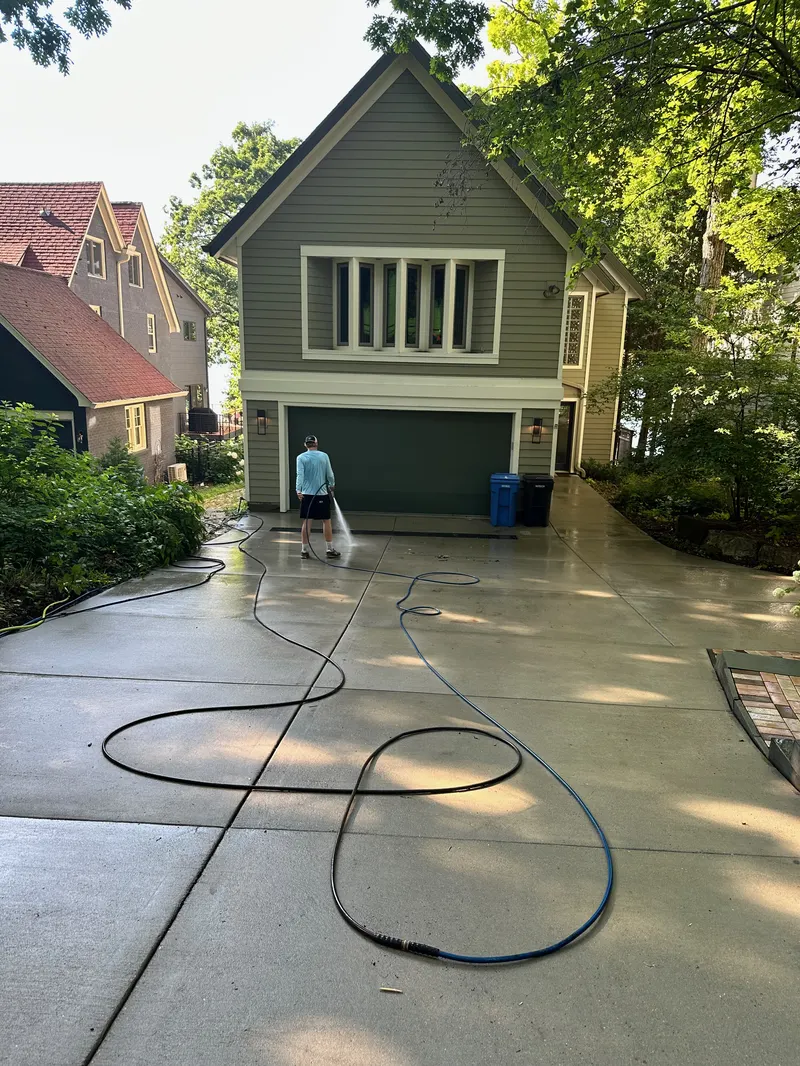
In depth
In Madison, concrete sealing after a professional pressure wash dramatically extends the time before road-salt damage, oil staining, and algae regrowth return. Penetrating sealers are the better choice for driveways exposed to heavy traffic and de-icing salt — they don't peel or wear away visibly and keep water out of the concrete's pore structure where freeze-thaw cycling does the most damage. We apply penetrating silane-siloxane sealer as an add-on after every driveway pressure wash for customers who want the clean to last more than one Wisconsin winter.
How this shows up on our jobs
We offer penetrating concrete sealer as an add-on service after every driveway and patio pressure wash. In Madison's salt climate, the ROI on sealing is immediate — it literally halves the frequency of cleanings needed.
Services where this matters
Frequently asked
- What is Concrete Sealer?
- A concrete sealer is a penetrating or film-forming coating applied to cleaned, dry concrete to reduce its absorption of oil, road salt, staining agents, and water. Penetrating sealers (silane, siloxane, or silane-siloxane blends) chemically bond below the surface to repel liquid without changing the appearance or traction of the concrete. Film-forming sealers (acrylic, epoxy, polyurethane) create a surface coating that is visible as a sheen and provides excellent stain resistance but requires periodic reapplication as it wears.
- How does Concrete Sealer show up on our jobs?
- We offer penetrating concrete sealer as an add-on service after every driveway and patio pressure wash. In Madison's salt climate, the ROI on sealing is immediate — it literally halves the frequency of cleanings needed.
Need surface cleaning in Madison?
Free quotes — most estimates back within a few hours. Prefer to talk? Call us anytime.
Related terms
Polymer Sealer
A polymer sealer is a protective coating applied to a cleaned and dried surface — glass, concrete, wood, metal, brick — that forms a long-molecule chain on the surface to repel water, dirt, and staining. In window cleaning, glass-specific polymer sealers (often silicon-dioxide based, sometimes called "glass coats" or "hydrophobic treatments") cause rain to bead and sheet off, which keeps windows cleaner 2-3x longer between professional cleanings. On concrete, acrylic or urethane sealers protect against oil, rust, and de-icing salt.
Efflorescence
Efflorescence is the white, chalky, powdery deposit that forms on the surface of brick, concrete, stone, stucco, and block masonry when water dissolves mineral salts inside the material and carries them to the surface. As the water evaporates, the salts are left behind as a crystalline residue. It is cosmetic — not structural — but it is frustratingly persistent because every rain cycle can push more salts to the surface.
Oxidation
Oxidation is the chemical reaction between a surface and oxygen (plus UV light, moisture, and time) that produces a chalky, faded, or dulled appearance. On vinyl siding, oxidation shows up as a powdery white residue that rubs off on your hand. On fiberglass doors and garage doors, it is a milky film that makes the surface look faded. On aluminum gutters, it appears as a crusty, chalk-like coating called "tiger striping" when rain streaks it. On painted metal, oxidation is the precursor to true rust.
Acid Wash
An acid wash in exterior cleaning is the application of a dilute acidic solution — most commonly muriatic (hydrochloric), phosphoric, oxalic, or a proprietary masonry blend — to dissolve mineral-based staining that bleach and surfactants cannot touch. Typical targets include efflorescence on brick, heavy rust from fertilizer or irrigation, mortar haze on new brickwork, mineral deposits on glass, and battery acid on concrete. Acid wash is not a general cleaning method — it is a targeted chemistry tool for specific stains on specific substrates.
Anti-Slip Treatment
Anti-slip treatment is a chemical process — sometimes followed by a mechanical treatment — that increases the coefficient of friction on hard-surface flooring to reduce slip-and-fall risk when the surface is wet. The most common chemistry for stone, porcelain tile, and concrete is a mild hydrofluoric-acid-based etchant that micro-pits the surface invisibly, creating thousands of tiny suction cups that grip wet shoe soles. On glazed tile and quartz, polymer-bonded non-slip coatings add a textured clear layer that does the same job without etching.