Screen Washing
Screen washing is the process of removing, cleaning, and reinstalling window screens during a window cleaning service. Screens accumulate dust, pollen, dead insects, and oxidation on both sides over time, and a dirty screen significantly reduces the clarity and light transmission of a clean window pane behind it. Professional screen washing involves removing each screen from its frame, laying it flat and spraying it with a gentle detergent solution, scrubbing with a soft brush, rinsing thoroughly, and allowing to dry in a vertical position before reinstallation.
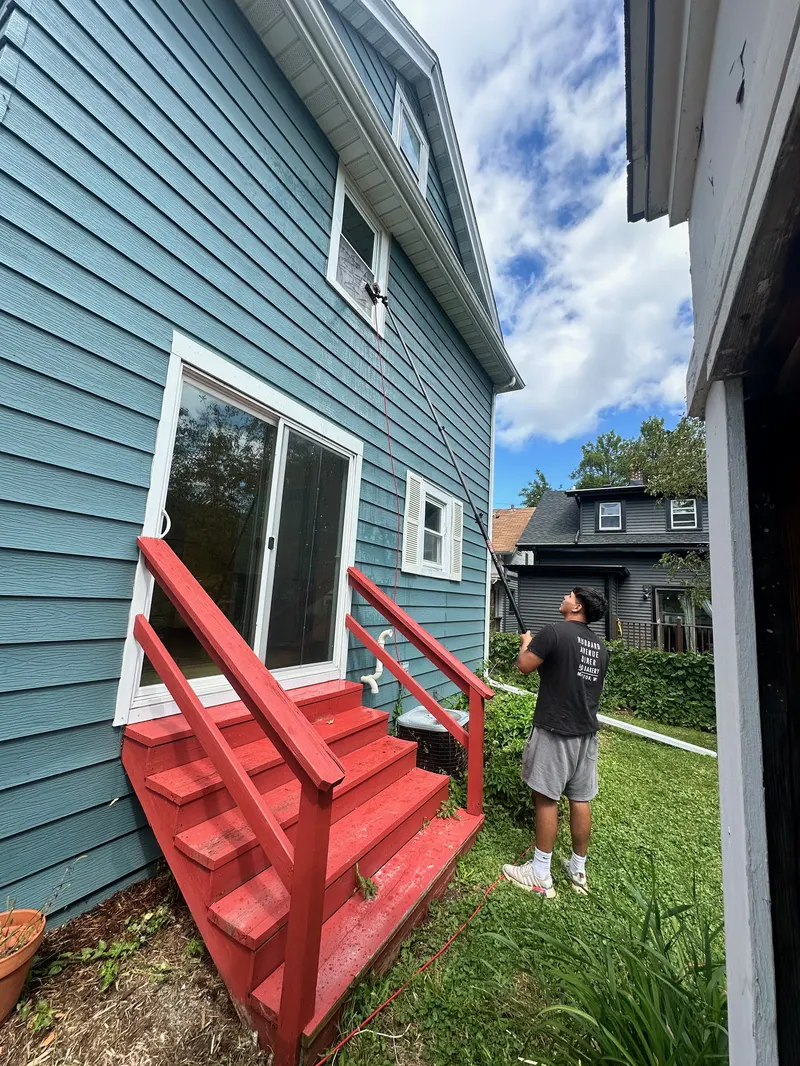
In depth
In Madison, pollen season in May and June is the primary driver of screen buildup — cottonwood fluff and maple pollen pack screens densely and reduce airflow. Screens that are not washed at the same time as windows leave a visible shadow on the glass view and re-deposit pollen and dust onto the clean pane when breezes blow through. We include screen washing in every full window cleaning package and track screen condition for customers whose fiberglass mesh is becoming brittle or delaminating from the frame.
How this shows up on our jobs
Screen washing is included in every window cleaning we do in Madison. The difference in light quality through a freshly screen-washed window is immediately visible, and customers always notice.
Services where this matters
Frequently asked
- What is Screen Washing?
- Screen washing is the process of removing, cleaning, and reinstalling window screens during a window cleaning service. Screens accumulate dust, pollen, dead insects, and oxidation on both sides over time, and a dirty screen significantly reduces the clarity and light transmission of a clean window pane behind it. Professional screen washing involves removing each screen from its frame, laying it flat and spraying it with a gentle detergent solution, scrubbing with a soft brush, rinsing thoroughly, and allowing to dry in a vertical position before reinstallation.
- How does Screen Washing show up on our jobs?
- Screen washing is included in every window cleaning we do in Madison. The difference in light quality through a freshly screen-washed window is immediately visible, and customers always notice.
Need window cleaning in Madison?
Free quotes — most estimates back within a few hours. Prefer to talk? Call us anytime.
Related terms
Water-Fed Pole (WFP)
A water-fed pole is a lightweight telescoping pole — typically carbon fiber, 20 to 45 feet long — with a soft brush and water jets at the tip, fed by a hose connected to a pure-water filtration system. The technician agitates the glass with the brush while pure water rinses away the loosened dirt, leaving zero mineral residue to dry into spots. When done correctly, windows, frames, and screens air-dry crystal-clear without ladders or squeegees.
Soft-Bristle Brush
A soft-bristle brush is the wash head of a water-fed pole or the hand tool used to gently agitate a surface during cleaning without damaging the substrate. For glass, a double-row flocked nylon or hog-hair brush is standard. For painted siding, soffit, and screens, a rotary or flagged polypropylene brush of medium-soft density is the norm. The goal is always enough mechanical action to lift dirt from the surface without micro-scratching the paint, glass coating, or finish.
Deionized Water
Deionized water — often shortened to DI water — is water that has had essentially all of its dissolved mineral ions removed by passing it through specialized ion-exchange resin beads. Positive-charge ions (sodium, calcium, magnesium) are swapped for hydrogen ions, and negative-charge ions (chloride, sulfate, bicarbonate) are swapped for hydroxide ions. The result is near-pure H2O with a TDS reading at or near zero.
Squeegee Technique
Squeegee technique refers to the controlled hand-motion pattern used to remove cleaning solution and water from interior window glass without leaving streaks, drips, or wet edges. A professional squeegee technique uses an 18 or 22-inch stainless channel with a fresh rubber blade, a consistent angle (typically 30-45 degrees to the glass), overlapping strokes that catch the entire wet field, a final detail swipe along the bottom edge and sill, and immediate detailing of any missed water around frames and corners with a chamois or lint-free cloth.