Soft-Bristle Brush
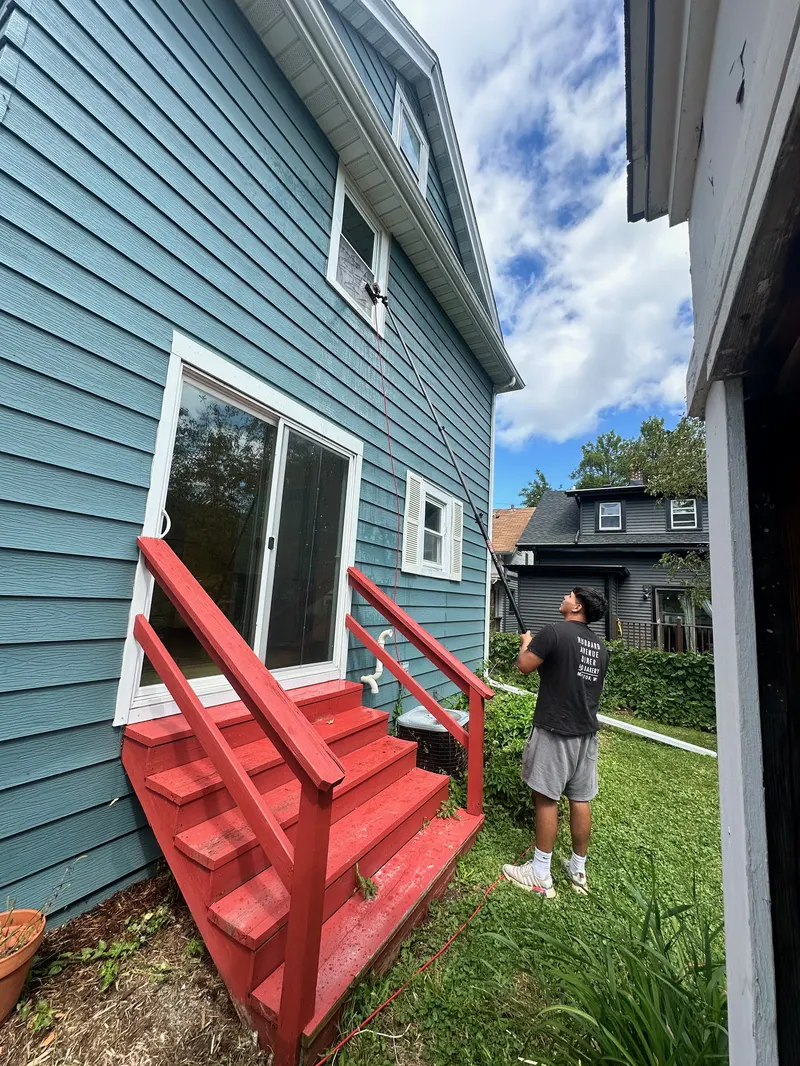
A soft-bristle brush is the wash head of a water-fed pole or the hand tool used to gently agitate a surface during cleaning without damaging the substrate. For glass, a double-row flocked nylon or hog-hair brush is standard. For painted siding, soffit, and screens, a rotary or flagged polypropylene brush of medium-soft density is the norm. The goal is always enough mechanical action to lift dirt from the surface without micro-scratching the paint, glass coating, or finish.
In depth
Bristle selection matters more than most homeowners realize. A brush too stiff scratches glass permanently and can mar painted surfaces. A brush too soft won't dislodge atmospheric fallout, spider webs, or oxidation residue. Professionals carry several bristle densities and match them to substrate: stiffest for concrete and brick, medium for painted vinyl, softest for glass and cedar. A quality brush also has a rubber bumper around the outer edge to protect frames, and flagged tips (split fibers) that carry more water and clean more efficiently per pass.
How this shows up on our jobs
We carry three brush densities on every truck and swap them based on substrate. A scratched pane or a dull-painted soffit from the wrong brush is a callback no one wants.
Services where this matters
Frequently asked
- What is Soft-Bristle Brush?
- A soft-bristle brush is the wash head of a water-fed pole or the hand tool used to gently agitate a surface during cleaning without damaging the substrate. For glass, a double-row flocked nylon or hog-hair brush is standard. For painted siding, soffit, and screens, a rotary or flagged polypropylene brush of medium-soft density is the norm. The goal is always enough mechanical action to lift dirt from the surface without micro-scratching the paint, glass coating, or finish.
- How does Soft-Bristle Brush show up on our jobs?
- We carry three brush densities on every truck and swap them based on substrate. A scratched pane or a dull-painted soffit from the wrong brush is a callback no one wants.
Need window cleaning in Madison?
Free quotes — most estimates back within a few hours. Prefer to talk? Call us anytime.
Related terms
Water-Fed Pole (WFP)
A water-fed pole is a lightweight telescoping pole — typically carbon fiber, 20 to 45 feet long — with a soft brush and water jets at the tip, fed by a hose connected to a pure-water filtration system. The technician agitates the glass with the brush while pure water rinses away the loosened dirt, leaving zero mineral residue to dry into spots. When done correctly, windows, frames, and screens air-dry crystal-clear without ladders or squeegees.
Deionized Water
Deionized water — often shortened to DI water — is water that has had essentially all of its dissolved mineral ions removed by passing it through specialized ion-exchange resin beads. Positive-charge ions (sodium, calcium, magnesium) are swapped for hydrogen ions, and negative-charge ions (chloride, sulfate, bicarbonate) are swapped for hydroxide ions. The result is near-pure H2O with a TDS reading at or near zero.
Dustless Grinding
Dustless grinding is the use of a HEPA-filtered vacuum attached directly to a grinder, sander, or surface prep tool to capture dust at the source before it can become airborne. Traditional grinding — on concrete patios, stucco repair, paint prep, or mortar removal — generates silica-laden dust that is a serious OSHA-regulated health hazard and a nightmare for homeowners whose gardens, pools, and cars are downwind. Dustless grinding captures 95-99% of that dust at the tool, collecting it in a vacuum for safe disposal.
Ladder Stabilizer
A ladder stabilizer (sometimes called a standoff or wall extension) is a steel or aluminum arm that bolts to the top rails of an extension ladder, extending the contact points out past the gutters and spreading the load across a wider wall area. Without one, a ladder rests directly on the gutter — which bends the gutter, damages the drip edge, pinches the roof line, and creates a narrow two-point contact that can slide sideways. A stabilizer keeps the ladder off the gutter, distributes weight across a 48-inch span, and dramatically improves both safety and the homeowner's gutter.