Oil Stain Degreaser
An oil stain degreaser is an alkaline or solvent-based cleaner that breaks petroleum oil and grease into particles water can rinse away. On concrete, which soaks up oil like a sponge, the degreaser is left to dwell, scrubbed in, and rinsed, often with hot water, because pressure alone only pushes oil deeper.
Need this done on your property? See our pressure washing in Madison page.
In depth
Fresh spills respond well, while old stains have soaked in and may only fade. Pros often blot first, apply degreaser, agitate with a stiff brush, rinse, and repeat. A poultice can pull remaining oil out of porous slabs. Runoff contains oil and must not reach storm drains, so it is contained or collected. Parking stalls, loading docks, garage floors, and driveways under leaking cars are the usual targets, and a concrete sealer afterward keeps new drips from soaking in.
How this shows up on our jobs
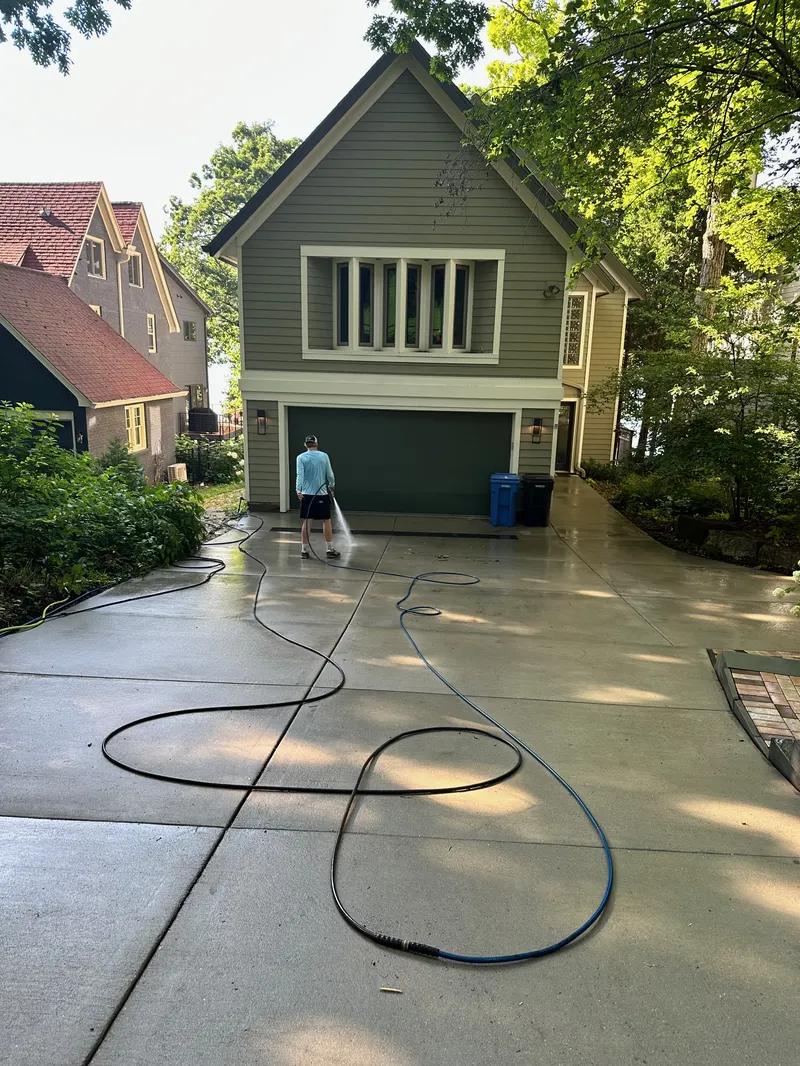
Madison storm drains run to the lakes, so oily runoff is a real concern. For driveways, parking stalls, and loading docks we degrease, agitate, and manage the rinse water rather than simply blasting it away.
Services where this matters
Frequently asked
- What is Oil Stain Degreaser?
- An oil stain degreaser is an alkaline or solvent-based cleaner that breaks petroleum oil and grease into particles water can rinse away. On concrete, which soaks up oil like a sponge, the degreaser is left to dwell, scrubbed in, and rinsed, often with hot water, because pressure alone only pushes oil deeper.
- How does Oil Stain Degreaser show up on our jobs?
- Madison storm drains run to the lakes, so oily runoff is a real concern. For driveways, parking stalls, and loading docks we degrease, agitate, and manage the rinse water rather than simply blasting it away.
Need driveway & garage degreasing in Madison?
Free quotes — most estimates back within a few hours. Prefer to talk? Call us anytime.
Related terms
Alkaline Cleaner
An alkaline cleaner is a high-pH detergent (typically pH 10-14) that dissolves oil, grease, fats, protein stains, and atmospheric grime by saponifying fatty acids and emulsifying petrochemical contaminants. The most common alkaline ingredients in exterior cleaning are sodium hydroxide (caustic soda), sodium metasilicate, and potassium hydroxide, often combined with surfactants, chelators, and dye. Alkaline cleaners are the counterpart to acid cleaners — pros reach for alkaline chemistry when the stain is organic or petrochemical, and acid when the stain is mineral.
Poultice
A poultice is a paste-like cleaning compound applied to a porous surface — natural stone, unsealed concrete, brick, limestone — to draw a stain out of the pores through capillary action. The paste is spread roughly a quarter-inch thick over the stain, covered with plastic, and left to dwell for 24-48 hours. As the poultice slowly dries, it pulls the dissolved stain out of the substrate into itself, where it can be scraped off and discarded.
Hot Water Pressure Washing
Hot water pressure washing uses a diesel-fired burner to heat the pressure washer's output to 180-200°F before it hits the surface. The physics is simple: hot water dissolves grease and oil, accelerates chemical reactions, lowers the dwell time needed for detergent to work, and kills biological growth on contact. Cold-water pressure washing relies on mechanical force and chemistry alone, which means longer jobs and lower performance on greasy substrates.
Dwell Time
Dwell time is the interval between applying a cleaning chemistry to a surface and rinsing it off. It is the single most misunderstood variable in exterior cleaning. Chemistry does not clean instantly; it needs time to break chemical bonds, kill organisms, or dissolve minerals. Too little dwell and the chemistry is wasted. Too much dwell — especially in direct sun — and the chemistry can damage the surface, bleach landscaping, or drive the stain deeper.
Rinse Water Management
Rinse water management refers to the planning and technique used to control where cleaning solution runoff goes during a wash job — protecting landscaping, drainage systems, neighboring properties, and storm drains from concentrated cleaning chemistry. In exterior cleaning, the primary concerns are: bleach runoff from soft washing contacting plants and grass (pre-soaking and rinsing minimizes damage); alkaline degreaser runoff entering storm drains (requires containment in commercial settings); and acid runoff from masonry work contacting metals and live plants.
Concrete Sealer
A concrete sealer is a penetrating or film-forming coating applied to cleaned, dry concrete to reduce its absorption of oil, road salt, staining agents, and water. Penetrating sealers (silane, siloxane, or silane-siloxane blends) chemically bond below the surface to repel liquid without changing the appearance or traction of the concrete. Film-forming sealers (acrylic, epoxy, polyurethane) create a surface coating that is visible as a sheen and provides excellent stain resistance but requires periodic reapplication as it wears.