Pressure Washer Nozzle Degrees
Pressure washer nozzle degrees describe how wide the spray fans out. Zero degrees is a pinpoint jet, 15 degrees is a narrow cutting fan, 25 degrees is the general cleaning fan, 40 degrees is a gentle wide rinse, and 65 degrees is the low-pressure soap tip. A smaller number means more force on a smaller spot.
Need this done on your property? See our pressure washing in Madison page.
In depth
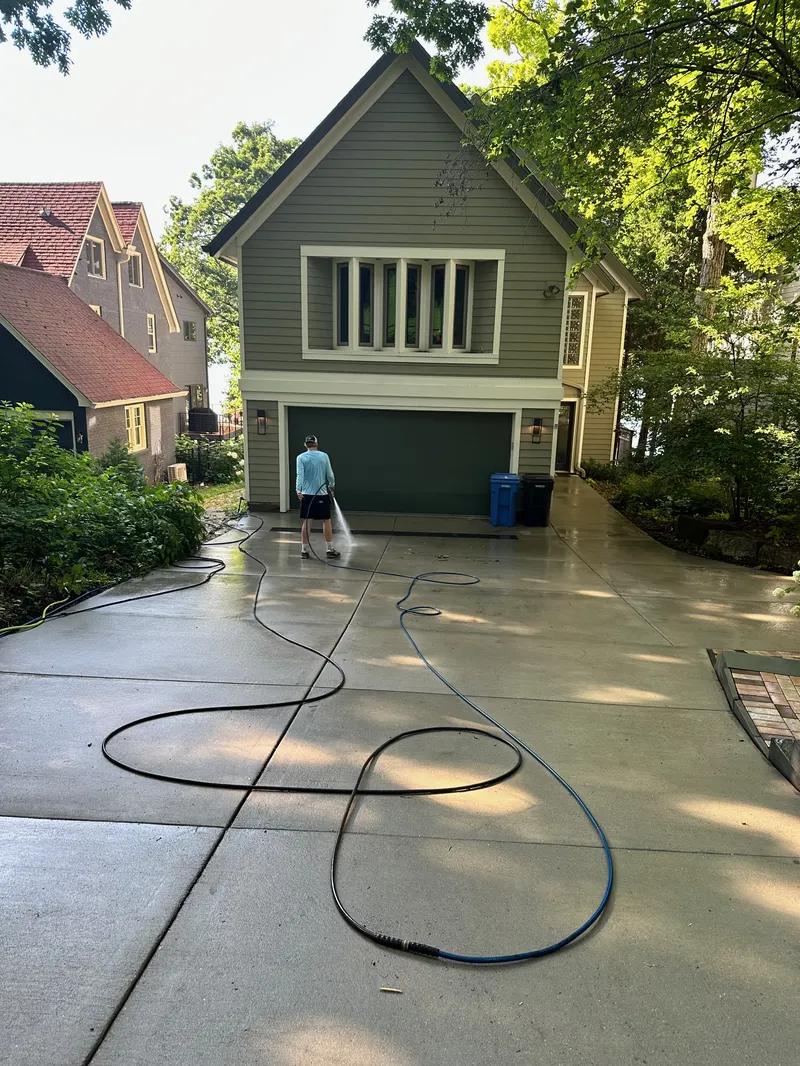
Tips are usually color coded to match: red for 0, yellow for 15, green for 25, white for 40, and black for soap. Colors are a convention, so check the number stamped on the tip. Pros choose the widest tip that still does the job. A 25-degree tip suits concrete, a 40-degree tip is the safer choice near wood, vinyl, and painted trim, and a 0-degree tip should never be pointed at a house. Distance matters as much as angle, because the same tip is far gentler from further away.
How this shows up on our jobs
In Madison we keep painted fascia, aging cedar, and window seals away from narrow tips. Most of our exterior work is low-pressure soft wash, so nozzle choice matters mainly on concrete, brick, and other hard flatwork.
Services where this matters
Frequently asked
- What is Pressure Washer Nozzle Degrees?
- Pressure washer nozzle degrees describe how wide the spray fans out. Zero degrees is a pinpoint jet, 15 degrees is a narrow cutting fan, 25 degrees is the general cleaning fan, 40 degrees is a gentle wide rinse, and 65 degrees is the low-pressure soap tip. A smaller number means more force on a smaller spot.
- How does Pressure Washer Nozzle Degrees show up on our jobs?
- In Madison we keep painted fascia, aging cedar, and window seals away from narrow tips. Most of our exterior work is low-pressure soft wash, so nozzle choice matters mainly on concrete, brick, and other hard flatwork.
Need surface cleaning in Madison?
Free quotes — most estimates back within a few hours. Prefer to talk? Call us anytime.
Related terms
Turbo Nozzle
A turbo nozzle, also called a rotary nozzle, is a pressure washer tip that spins a zero-degree jet in a tight cone. It cleans almost as hard as a pencil-point tip but covers a wider path, so it is used on tough flat surfaces like concrete, never on siding, windows, or roofs.
PSI (Pounds per Square Inch)
PSI is the unit of pressure used to rate pressure washers, measuring the force of water exiting the pump per square inch of surface area. Consumer pressure washers run 1,500-2,500 PSI; professional rigs typically produce 3,500-5,000 PSI; and specialty surface cleaners can spike above 8,000 PSI. Higher PSI is not always better — in fact, for most home exterior surfaces, high PSI is destructive. Vinyl siding, wood shingles, soft mortar, roof granules, and painted surfaces all fail under excessive pressure.
GPM (Gallons per Minute)
GPM stands for Gallons Per Minute — the volume of water a pressure washer delivers per minute of operation. While PSI gets the headlines, GPM is what actually does the cleaning. Think of it this way: PSI is the hammer's strength; GPM is how many hammers you're swinging. Higher GPM means more water flowing across the surface, which means faster dirt removal, better rinsing of detergents, and shorter job times.
Pressure vs. Volume
Pressure (PSI) and volume (GPM) are the two fundamental outputs of a pressure washer, and understanding the tradeoff between them is the single biggest step an amateur can take toward professional-level results. Pressure is the force of water hitting a single point; volume is the amount of water moving across a surface over time. A high-PSI, low-GPM machine cleans a tiny spot aggressively — great for lifting paint, terrible for washing a driveway. A moderate-PSI, high-GPM machine cleans broadly and gently — great for siding, wood, and most large surfaces.
Soft Wash
Soft washing is a low-pressure exterior cleaning method that uses biodegradable detergents and a controlled bleach solution to kill the algae, mold, mildew, and bacteria that cause staining — rather than scouring them off with brute force. A soft wash rig delivers cleaning fluid at roughly 60-200 PSI, comparable to a strong garden hose, which is safe on siding, shingles, painted surfaces, screens, and caulking. The chemistry does the work: the solution dwells on the surface, breaks down the organic growth at the cell level, and is then rinsed clean with fresh water.