Storefront Window Cleaning
Storefront window cleaning is the routine cleaning of a business's street-level glass, doors, frames, and sills so the entrance stays clear and inviting. It is done on a repeating schedule, often before opening hours, because customers read the glass as a signal of how well the whole business is run.
Need this done on your property? See our window cleaning in Madison page.
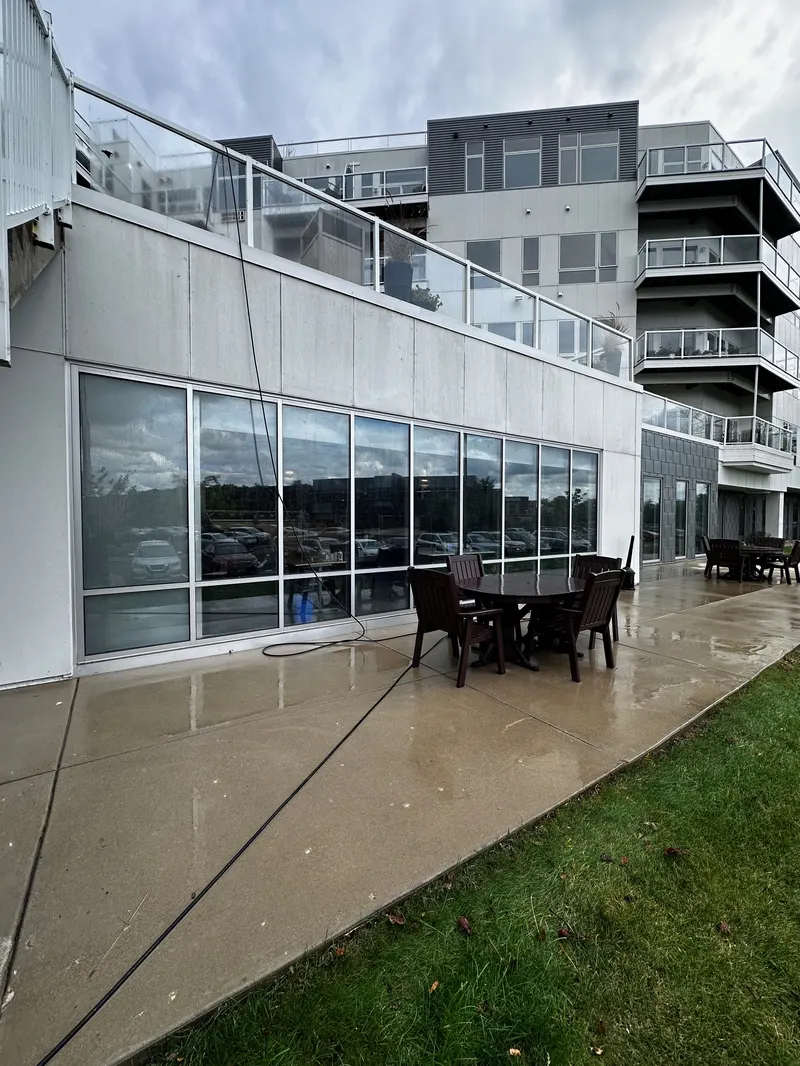
In depth
Commercial glass collects fingerprints, door-handle grime, salt spray, and pollen every day. Frequency depends on foot traffic and season: a busy entrance may need weekly service, a quiet office much less. Crews clean door glass, push plates, transoms, sills, and frames, and note scratches or failed seals. Winter salt etches glass if left in place, so many businesses add a cleaning in late winter. Professional service also covers insurance, scheduling around customers, and sidewalk safety.
How this shows up on our jobs
State Street, the Square, and suburban retail strips in Madison all see heavy salt and foot traffic. A recurring route keeps the front of your business consistent without you having to think about it.
Services where this matters
Frequently asked
- What is Storefront Window Cleaning?
- Storefront window cleaning is the routine cleaning of a business's street-level glass, doors, frames, and sills so the entrance stays clear and inviting. It is done on a repeating schedule, often before opening hours, because customers read the glass as a signal of how well the whole business is run.
- How does Storefront Window Cleaning show up on our jobs?
- State Street, the Square, and suburban retail strips in Madison all see heavy salt and foot traffic. A recurring route keeps the front of your business consistent without you having to think about it.
Need commercial window cleaning in Madison?
Free quotes — most estimates back within a few hours. Prefer to talk? Call us anytime.
Related terms
Pure Water Window Cleaning
Pure water window cleaning washes glass with purified, mineral-free water delivered through a long pole with a soft brush, then lets the glass air dry. Because no dissolved minerals remain, the glass dries spot-free without squeegeeing, and the pole reaches upper windows safely from the ground.
Squeegee Technique
Squeegee technique refers to the controlled hand-motion pattern used to remove cleaning solution and water from interior window glass without leaving streaks, drips, or wet edges. A professional squeegee technique uses an 18 or 22-inch stainless channel with a fresh rubber blade, a consistent angle (typically 30-45 degrees to the glass), overlapping strokes that catch the entire wet field, a final detail swipe along the bottom edge and sill, and immediate detailing of any missed water around frames and corners with a chamois or lint-free cloth.
Water-Fed Pole (WFP)
A water-fed pole is a lightweight telescoping pole — typically carbon fiber, 20 to 45 feet long — with a soft brush and water jets at the tip, fed by a hose connected to a pure-water filtration system. The technician agitates the glass with the brush while pure water rinses away the loosened dirt, leaving zero mineral residue to dry into spots. When done correctly, windows, frames, and screens air-dry crystal-clear without ladders or squeegees.
Winter Salt Stains
Winter salt stains are the white, chalky film left on concrete, brick, vehicles, entry floors, and the base of siding when road salt and de-icers dry out. They are mineral deposits, not dirt, so soap alone does not lift them. They dissolve with plenty of fresh water, and often a mild salt-specific or acidic cleaner.
Hard Water Stain
A hard water stain is the crystalline mineral deposit that forms on glass, metal, and stone when water high in dissolved calcium, magnesium, iron, or silica evaporates and leaves its dissolved minerals behind. The stain starts as a cosmetic film that rinses off easily; over weeks or months, it bonds chemically to the surface and etches into it, becoming progressively harder to remove. On glass, severe hard-water staining is technically etching — the minerals have chemically fused into the silicate surface and cannot be washed off without specialty chemistry or mechanical polishing.